Although Britannica is the oldest English-language general encyclopaedia, I still prefer keeping Wikipedia. Here are the reasons:
A. Totally Free Accessing
Comparing with Britannica, Wikipedia is a free accessing website whereas Britannica is not totally free. Though some people may argue that Britannica could offer short versions of articles for free and it is worth charging US$69.95 a year for full entry [1], Britannica is still expensive for most people especially students. As a result, it would be cheaper for the users when the users want to search the same information in the Wikipedia.
B. Wider Categories of Content
As claimed in the official website of Britannica, it mainly focuses on the arts and sciences [2] which implied the variety of Britannica is narrower. For examples, I tried to search ‘Paris Whitney Hilton’ (an American celebrity) on both Britannica and Wikipedia so as to differentiate the difference. For the Britannica, the browser shows ‘the topic Paris Hilton is discussed at the following external Web sites.’ And the external website is the official website of Paris Hilton. [3] In other words, this search is a little bit useless. However, when I search ‘Paris Whitney Hilton’ in Wikipedia, there is a long article about her in details. [4] Moreover, Wikipedia not only includes the profile of Paris Hilton, but also the crimes she involved which are not included in her official website. All in all, Britannica may be good at arts and sciences subjects, but not other issues. A 2008 study conducted by researchers
 |
| Result of Pris Hilton in Wiki |
 |
| Result of Paris Hilton in Britannica |
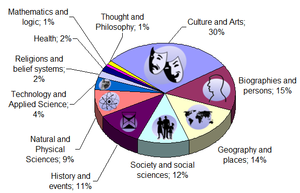
Wikipedia is an open editing website, almost all of its articles can be edited by anyone with access to the site so the bias of the contents will be minimized. Since the opinions of large spectrum of people can be included, the objective opinions of certain controversial issues can be maintained. However, Britannica is not. It cannot be edited by anyone, users CAN ONLY GIVE SUGGESTIONS to the editorial team which means only the editorial team has the right to select and change the contents. Some less desirable contents may thus be omitted or neglected. Therefore, the coverage of the opinions in Britannica is not as wide as Wikipedia.
D. Accuracy
The accuracy of the contents of Wikipedia is always criticized by most scholars. Moreover, a lot of schools do not encourage their students to include the contents from Wikipedia because the authors or editors are not professionals and have unknown academic background. However, according to the journal Nature cited in BBC news, it suggested that for scientific articles, Wikipedia came close to the level of accuracy of Encyclopaedia Britannica and had a similar rate of "serious errors.[8]
E. Up-to-date Content
Last but not least is the up-to-date content of Wikipedia. Take Manila hostage crisis happened on the 23rd August 2010 as an example, a page about this incident is created immediately on the same date in the Wikipedia. [9] Contrary to Wiki, I cannot find any articles of this incident in Britannica. Therefore, if users want to look up some information about current issues, using Wikipedia will be more convenient for the users because of the real time update.
Conclusion
Every coin has two sides, both Wikipedia and Britannica have their advantages and disadvantages. Although Wikipedia has its drawbacks, the benefits of Wikipedia overweigh the benefits of Britannica.
Bibliography:
[5] Kittur, A., Chi, E. H., and Suh, B. 2009. What’s in Wikipedia? Mapping Topics and Conflict Using Socially Annotated Category Structure In Proceedings of the 27th international Conference on Human Factors in Computing Systems

沒有留言:
張貼留言